



by Renata Brito
Alexandre Deitos studied the shaky video taken by a fisherman as it panned across the small boat stuck on a sandbank.
He sighed. Inside the craft were eight decomposing bodies and a ninth was floating nearby. Deitos knew his grim job would not be easy: identifying the dead.
In a long career with the Brazilian police, the criminal forensic investigator had put names to corpses mangled in plane crashes, crushed beneath collapsed buildings and buried in mudslides. But he had never worked on a case like this.
His first mystery would be fairly easy to solve. In analyzing the contents of the boat, which included 28 mobile phones and two IDs, Deitos and his colleagues surmised the boat had originated in West Africa carrying migrants to Europe. Something had gone wrong, and the open 13-meter (42-foot) fishing boat had then drifted hopelessly for weeks across the Atlantic.
The next part would be harder: putting names to the bodies. He ran into roadblocks with officials in Africa. Some emails went unanswered and the little information shared led nowhere. Deitos and his boss realized they needed to take a different approach, and they turned to an unexpected place for a hand: “Would you help us?” Deitos asked me.
As an Associated Press reporter, I had written about such “ghost boats.” I had already been in touch with them for a story about this particular tragedy and shared with them my previous coverage.
Their request launched an unusual partnership between a police officer and a journalist to identify the boat’s passengers. Two years later, our work took us to the nation of Mauritania, in the Sahara Desert, to collect DNA from the grieving parents, wives and children of those who had perished on that fateful voyage.
The men on this boat were no different from the thousands of others who have disappeared in the Atlantic trying to reach Spain’s Canary Islands, on what some experts say is the world’s most dangerous migration route.
While the majority of the missing vanish without a trace in what are known as “invisible shipwrecks,” at least a dozen such boats have washed ashore in Latin America and the Caribbean in recent years. The United Nations’ International Organization for Migration estimates that more than 6,500 have died on the route since at least 2020. A Spanish migrant rights group, Walking Borders, says it has documented nearly 26,000 such deaths during the same period.
Tens of thousands of migrants have gone missing globally on land or sea journeys, whether crossing the Mediterranean Sea or the U.S.-Mexico border. While it is states’ responsibility to investigate and identify these victims, regardless of their nationality, they have largely failed, experts say. The U.N. migration agency has called the global crisis “one of the great political failures of modern times.”
An unusual partnership
When I saw news reports about the boat on a Saturday in April 2024, I called Brazilian authorities for comment and wrote a news story. A few days later, I got in touch with Deitos and his boss. They explained the Brazilian police had made no headway with authorities in West Africa.
Deitos said he considered the migrant crisis to be an international disaster that deserved more attention. In researching the problem, he said he had learned that many dead migrants are never properly identified, meaning their families never learn what happened to them. While he had gone overseas to identify Brazilian migrants who had died in Mexico and assisted in investigating international plane crashes, Deitos had never handled a case like this.
Brazil had investigated only one such “ghost boat,” in 2021, and police had failed to make any progress in identifying its victims.
He said he hoped his work on this case might become “a model for other countries” to follow.
“Each person has the right to be identified,” Deitos said.
“And each family has the right to receive the body of their loved one.”
However, Deitos and his boss said they were not sure how to proceed. He did not think he would get anywhere by sticking to official channels. He needed to identify the nine victims on the boat. To do that, he would have to locate their families.
Deitos thought I might know what to do because I had investigated a similar migrant tragedy in the Caribbean. That reporting had presented some of the same challenges facing Deitos and had required AP to locate relatives and friends of the victims to figure out who had embarked on that deadly journey.
I explained that I was in contact with many activists and community leaders who have documented hundreds of people missing after boarding such boats. Such grassroots networks, I explained, have sought to fill a void they say has been left by government inaction. With their help, I had already located family members of those who got on the boat.
Journalistic conventions dictate that we maintain distance from officials we cover. Deitos and his boss promised that any information I shared would be used solely for identification purposes. After receiving permission from my editors, I agreed.
The investigator
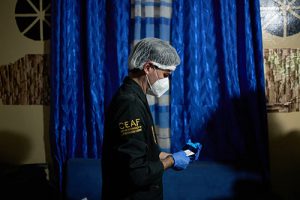
Deitos, a fit and trim 52-year-old father of one with brown hair and brown eyes, was a dentist before pivoting to forensic anthropology.
He joined the federal police in 2009 and, since 2013, has specialized in identifying victims of disasters. Until June, he had chaired Interpol’s working group on disaster victim identification.
Deitos and I quickly developed an easy working relationship, which was helped by the fact I am Brazilian and speak Portuguese.
Our first task was to figure out who was on the boat. We had some good clues: two IDs from Mali and Mauritania. We also had more than two dozen cell phones. Most were badly damaged by the salt water, but Deitos provided me with the data salvaged from a few of them, as well as several handwritten notes with names and phone numbers. I began making phone calls and started piecing together a list of potential passengers.
I spoke to mothers, wives, brothers and sisters of those who had boarded the boat. They directed me to relatives of other potential passengers.
I cross-checked the dates and locations of their disappearances and obtained photos of those who vanished. I shared photos of clothing, jewelry and personal objects that were found on the boat.
After months of work, we had a list of 30 potential victims who boarded the boat on Jan. 23, 2024, in Nouadhibou, Mauritania. Police only recovered the bodies of nine men, meaning survivors must have been tossing overboard the bodies of those who perished along the way.
Only DNA testing of relatives could confirm what we had been carefully piecing together.
That meant our next stop was in Africa.
Mauritania
We arrived in Mauritania in June. Over the previous two years, Deitos had not given up trying to win assistance from West African governments and international organizations. The International Committee of the Red Cross agreed to help him collect the DNA. Officials in Mauritania eventually cooperated, granting him permission to work in the country and accompanying him throughout the mission.
Escorted by the country’s police, we drove 1,500 kilometers (930 miles) across the Sahara Desert to meet with families. The heat was suffocating. Sand drifted across the road as we sped through an empty landscape except for scattered mosques and homes, mostly financed by migrants abroad.
One village was so remote that outside houses tall poles stood with baskets and ropes to hoist mobile phones high enough into the sky to get a signal.
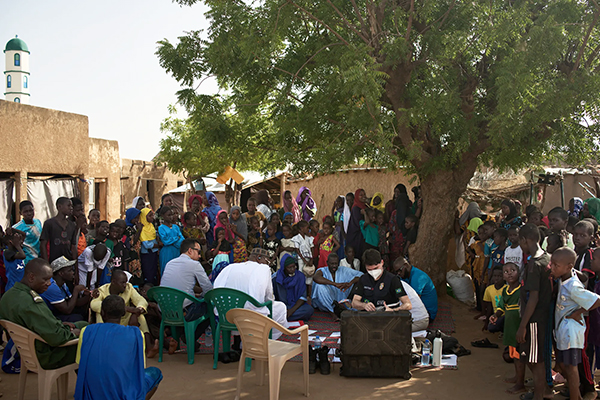
When we pulled up to Hassi Bagara, dozens of people hustled to greet us. We sat on a carpet under the shade of a large tree and answered their questions about Deitos’ mission.
We also learned about the men who had left and their families who stayed behind. The men had no jobs at home, and had hoped to find better opportunities in Europe.
It’s the same story in other West African communities, some of which face more threats, including from rising extremist violence and climate change.
Among the suspected passengers from the region was Issa Diakhité. His father, Sabara Diakhité, said he had accepted his son’s death, but other relatives were living in denial, preventing them from properly grieving.
“How to make his mother understand it?” Diakhité said. “How to make his brothers understand it? How can anyone understand it?”
Deitos listened and explained how DNA worked. The investigator donned a mask and put on latex gloves before gently swabbing the inside of the man’s cheeks for the cells necessary to make a DNA comparison.
The father thanked him for coming all the way from Brazil. It was rare for local officials to visit, he said, let alone foreign ones.
‘The road of death’

Few people were as prepared as Kadiatou Gassama for confirmation of the worst.
We met her in Mauritania’s capital, Nouakchott. Kadiatou said she knew her husband, Souleimane Gassama, had been on the boat. She had spoken with him hours before he boarded the vessel. His was one of the IDs police had recovered among the remains.
Without a funeral or death certificate, Kadiatou said she and her six children have struggled to register them for school exams, obtain her residency permit or apply for benefits. Thousands of relatives of missing migrants, especially wives, find themselves in a legal limbo that complicates their ability to remarry, inherit their husband’s property or even access bank accounts.
Kadiatou, an immigrant from Congo, said she lives in fear of being deported, and separated from her six children. A deal between Mauritania and the European Union to curb migration has led to a crackdown on immigrants like her. Without her husband, she said, she feels exposed.
For years, she said she tried to convince him to abandon his dream of migrating to Europe. She even threatened to divorce him if he took the perilous voyage. He agreed the trip would be dangerous, calling it “the road of death.” Nevertheless, he told his wife it was worth the risk: Several friends had reached Europe and were sending remittances to their families.
He told her the journey should take no more than three days.
The morning he left, with nothing more than a backpack, he asked for his wife’s forgiveness. After a few days without word from her husband, Kadiatou began to grow nervous. Her concern spiked with each passing day. She called the smuggler — her husband had left his number with her – but each time he gave a different excuse.
She joined a WhatsApp group created by relatives of migrants who had vanished on such trips.
She found others wondering what happened to her husband’s craft:
“Has your brother arrived?”
“No.”
“Has your father arrived?”
“No.”
Three months later, someone shared an article about a Mauritanian boat that washed up in Brazil. There were no survivors. Kadiatou felt a sudden urge to vomit.
Within days, an activist connected her with me. I told her that Brazilian authorities had found her husband’s ID and phone.
I shared with her some photos taken of the victims’ clothing, and she recognized a pair of boxer shorts. She was eager to provide DNA samples to confirm her worst fears.
