



by Isabel Debre, Nicole Winfield and Nyara Batschake
PAYSANDÚ, Uruguay — Pope Leo XIV urged an estimated 40,000 people in Uruguay on Saturday to build bridges of fraternity and faith, using his first Mass in South America to deliver an ode to the region’s beloved mate tea and raise the profile of the Catholic Church in its most secular country.
Leo spent his first full day in Uruguay pointing to the church’s historic roots in the country and the work it’s doing today, including in a violence-ravaged neighborhood of Montevideo where it has built homes, provided job opportunities and run drug rehabilitation programs.
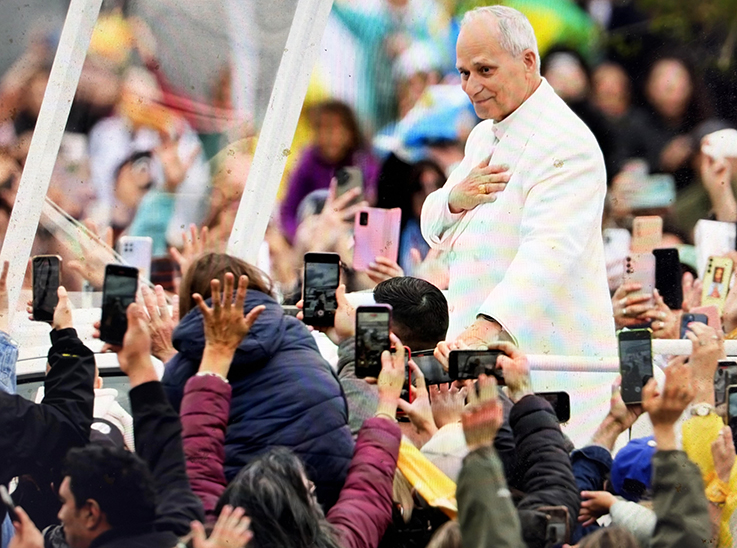
The crowd erupted in the stadium chant of “Olé, olé, olé, olé, pope, pope!” when Leo’s plane landed in Paysandú, in western Uruguay on the border with Argentina. They cheered again, blew horns and waved yellow handkerchiefs when he arrived in his open-sided popemobile at the Mass site in a park.
Speaking to the crowd in Spanish, Leo reminded them that the Catholic faith had been “part of the life of the Uruguayan people since their earliest days, and it must be passed on to future generations with creative courage!”
More than 30,000 people — many from Uruguay but also from neighboring Argentina and Brazil — had registered in advance to attend the service, around 375 kilometers (230 miles) from the capital, Montevideo. The Vatican said Saturday that another 10,000 had attended, despite the morning rain and blustery, gray skies.
Because of its accessible location on the Uruguay River, the city was chosen to host Leo’s first Mass at the start of his three-nation South American tour that was in doubt after he underwent lung cancer surgery on Oct. 13.
“He’s the representative of Christ but he’s human. And we weren’t sure if he could make it, but he pushed through for us,” said Soledad Sánchez, 73, who had driven to Paysandú from northern Uruguay, her eyes filling with tears. “He made it here to give us a message of peace because he knows our world needs it right now.”
A visit to try to propose the Catholic faith
Leo, who arrived in Uruguay on Friday, is urging the people in South America’s most secular country of 3.5 million to turn to the Catholic faith for strength in confronting today’s problems and challenges.
In his homily, Leo asked the faithful to build bridges of fraternity, recalling the nearby bridge over the Uruguay River that connects Uruguay and Argentina and over which many pilgrims crossed to attend the Mass.
He also pointed to the ritual of drinking mate, the bitter herbal tea that Uruguayans and their neighbors carry everywhere, as a poignant symbol of unity and encounter that he suggested should be applied to spreading the faith.
“It teaches us to share and to be together, strengthening the bonds that unite us as brothers and sisters,” he said. “It is a sign of welcome, integration and shared values.”
Mate, a cherished national symbol in Paraguay, Argentina and Uruguay, is above all a sharing ritual. The leaves are steeped in a hollowed gourd and the drink is sipped through a metal straw called a bombilla, and the gourd passes from hand to hand among friends, family and sometimes strangers, refilled for hours.
Everyone drinks from the same straw, and Uruguayans drink more mate per person than people anyone else, roughly 9 kilograms (about 20 pounds) of the dried leaf a year, according to industry estimates.
“We must reflect on these symbols that we share, which give us identity and a sense of belonging, which speak to us of our origins and point us toward the future,” Leo said.
The message landed.
“I’m not religious. I’d never go to Mass if it weren’t the pope, but he surprised me. He made it appealing, the way he talked about things we all have in common, like mate,” said Jorge Monzón, 64, from Paysandú. “I personally felt a sense of communion.”
An example of how the church is helping Uruguay
Leo pressed the message of the church’s commitment to helping Uruguayans later Saturday by visiting Casavalle, a Montevideo area of small neighborhood s beset by drug trafficking and gang violence. In Borro, the Our Lady of Guadalupe Parish builds homes and supports addicts in their recovery, with donations including from The Papal Foundation, the U.S.-based group of wealthy Catholics who fund special papal projects.
In his remarks in Borro, Leo praised the work church groups were doing and said Christians must commit themselves to the charity and closeness shown by the biblical figure of the good Samaritan, “who did not remain indifferent upon seeing misfortune, but took responsibility for his brother’s life.”
“We cannot turn a blind eye to the fact that there are children in Uruguay who do not go to school for fear of never returning home,” he said. “We cannot silence our conscience when we see a mother lacking the means to feed her children. We cannot ignore the many people around us who are suffering, alone and vulnerable.”
Uruguay has universal access to primary school and enrolls nearly all its children, but only about half of Uruguayans finish high school, one of the lowest rates in Latin America, according to the National Institute for Educational Evaluation. The graduation rate is even worse for children from the poorest households, where only one in four graduate compared to nearly 9 out of ten from the wealthiest families.
Jonathan Tropiano, 28, is one of the many in the area whose lives were transformed by the church.
He dreamed of becoming a rapper but was arrested after falling into crime and violence. Once out of the prison, at the age of 20, Tropiano became closer and closer to the local church.
“My life was horrible, with so much suffering. But then I found God and that was when I started to be a better person,” he said
Argentines flock to see Leo across the border
Saturday was Leo’s only full day in Uruguay before heading Sunday afternoon to Argentina for the second leg of his trip, which was to end next week in his second homeland of Peru.
Many Argentines, though, took advantage of the Paysandú Mass to see him since it was located just across a bridge from the eastern Argentine city of Colón and was closer to any of his Argentine stops in Buenos Aires, Luján and Córdoba.
“Argentina is a much more religious country than Uruguay, and there’s this desire to be here to witness something historic,” said Luciana Lobato, 20, an Argentine tour agent who organized buses for 180 pilgrims from across the border.
Some young Catholics involved in local church groups hoped the sight of a pope drawing crowds would challenge Uruguay’s image as a country indifferent to religion. Young pilgrims especially said Leo’s humane tone and emphasis on care for the vulnerable resonated beyond the faithful.
“I wouldn’t call myself religious, but I like this pope. He has a really good message for humanity,” said Santiago Biglieri, 18, a Colombian who lives in Uruguay. “Even for the nonbelievers, there’s something to take from his ideas.”
