



by Emeka Obasi
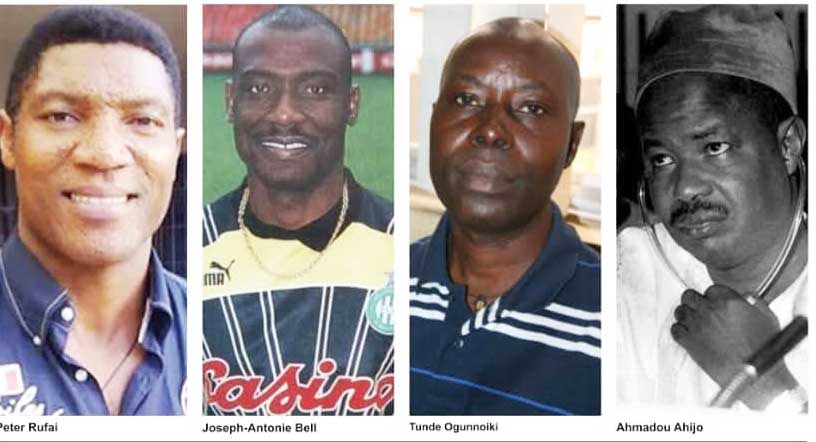
Memories of Peter Rufai remain with Cameroonians after the late goalkeeper stunned president Ahmadou Ahidjo right inside the national stadium named after their leader in Mfandena, Yaounde, in a 1981 African Winners Cup game.
In the first leg of the finals, Dodo Mayana, in goal for Stationery Stores, Lagos remained unbeaten and shocked the crowd when he saved Union Douala skipper, Francois Doumbe Lea’s penalty kick. The game ended goalless. That was the first time the hosts failed to score at home in that year’s competition which they eventually won.
Multilinguist and Veteran Journalist, Tunde Ogunnoiki who watched the match after a three – day tortuous journey from Lagos to Yaounde through Ikom, stayed mute on his seat after that save while Ahidjo screamed in disbelief.
Ogunnoiki said : “I was in the midst of murderous Cameroonian fans, so when Rufai caught that penalty kick by Doumbe Lea, captain of the country’s national team, president Ahidjo stood up in the State Box in surprise.” It was an uncomfortable situation. Ogunnoiki recalled that moment. “I could not rejoice as Rufai caught the kick. I would have been identified as a Nigerian. I was scared”, he added.
It was a sad day for Union Douala. A team that won the CAF Champions League in 1979 always scoring at least one goal at home in every game and had done so all through the 1981 African Winners Cup challenge, had that record stained by Rufai.
The Douala side was loaded. There was keeper Joseph – Antoine Bell and seasoned players like Rene N’Djeya, Bonaventure Djonkep, Joseph Kamga, Eugene Ekoule, Norbert Owona and Isaac Sinkot who was also known to admirers as Zimbabwe.
However, Ogunnoiki remembered the words of five young Union Douala supporters who mingled with Stores fans outside the stadium after the match. While the Nigerians chatted excitedly believing that the Lagos leg would be a done deal, the Cameroonians did not give up.
According to Ogunnoiki, “After the match, we gathered together and all believed that Stores would triumph in Lagos. Five boys chatting with me replied, ‘L’ Impossible n’est Pas Camerounais’ ( the word impossible does not exist in Cameroon).
Going back to Lagos with Stores supporters in the Sports Council bus was not given any consideration, following the experience of nearly missing the game in Yaounde. Ogunnoiki was not part of the players and officials that made it by air. He did not fail to remind me of that long trip.
“I travelled by road with other Stores supporters. We left Lagos on Friday morning and invariably got to the Ikom border on Saturday morning. At 8am when we proceeded to enter the Cameroonian side of the border, to start our trip to Yaounde, I spoke in French with a Customs official.
“When he heard that we were going for the game billed for 3 pm on Sunday, he asked if I believed that we could get to the stadium before the match. This was on Saturday morning, by 8 am, about 30 hours before the match. Obviously, we had taken taken a long arduous route. About five kilometres to the stadium, our bus packed up.”
The adventure got more interesting. “I had to get a ride on a truck, sitting with goats. My French got me the ride and two others joined me as we rode with the animals. Barely three minutes after I entered the stadium, the game started. All the others who came by road only arrived after the match”, Ogunnoiki added.
Rufai did not conclude the Lagos leg. A bad day it was as James Wariebi came on as substitute. The reserve goalie, better known as Inufele ( Yoruba for flat stomach) could not stop Union Douala from winning the trophy through Ekoule’s brace. Yisa Alabi, revered for scoring vital goals and nicknamed Anobi (Prophet) had no answer.
Ahidjo supported Nigeria against Biafra during the Civil War but he would not forget Nigerian footballers. When the stadium was opened as Stade Omnisport on February 13, 1972, the Green Eagles defeated the Indomitable Lions 2-1. The very first goal was scored by Jossy Dombraye. Till date, there is a seat bearing that name in there. One Green Eagle, Ifeanyi Onyedika, chose the nickname, Ahidjo.
Ogunnoiki, who studied French at the University of Ife, fell in love with the never say die spirit of Cameroonians even before that Yaounde experience.( Remarkably, since 1981, Union Douala have continued to lose to Nigerian teams, from Rangers in 2005, to Kwara United in 2008 and Warri Wolves in 2014). He was an Interpreter during the 1981 West African Universities Games (WAUG) held at University du Cote d’Ivoire, Abidjan and came across Cecile Ngambi and other female athletes.
Ngambi is the first Cameroonian female Olympian. She won the WAUG 100m Hurdles and bagged another gold in High Jump. What struck the Nigerian was that the girls behaved like Lagos commuters, always sitting close to the exit of the bus and hopping down while it was was in slow motion.
Ngambi bore Cameroon’s flag at the Opening Ceremony of the Sydney 2000 Olympic Games, twenty long years after her debut at Moscow 1980. Issa Hayatou was the flag bearer at Los Angeles 1984. He was a basketballer and quarter miler. That was the year the Nigerian quartet of Innocent Egbunike, Sunday Uti, Oluwarotimi Peters and Moses Ugbisien won 4x400m relay bronze.
Egbunike and Ngambi won medals at the 1985 African Athletics Championships in Cairo. The Nigerian bagged gold in the 400m and silver in the 200m. The Cameroonian left with silver in the 100m Hurdles, losing to Maria Usifo. Nigeria topped the table with 11 gold, 10 silver and 3 bronze medals.
Gold medalists included double champions, Paul Emordi and Rufina Uba, Chidi Imo, Christian Okoye, Kehinde Vaughan, the men’s 4x100m quartet of Iziaq Adeyanju, Ikpoto Aseme, Victor Edet, Chidi Imo and the women’s 4×400 team of Airat Bakare, Maria Usifo, Kehinde Vaughan and Sadia Showunmi.
